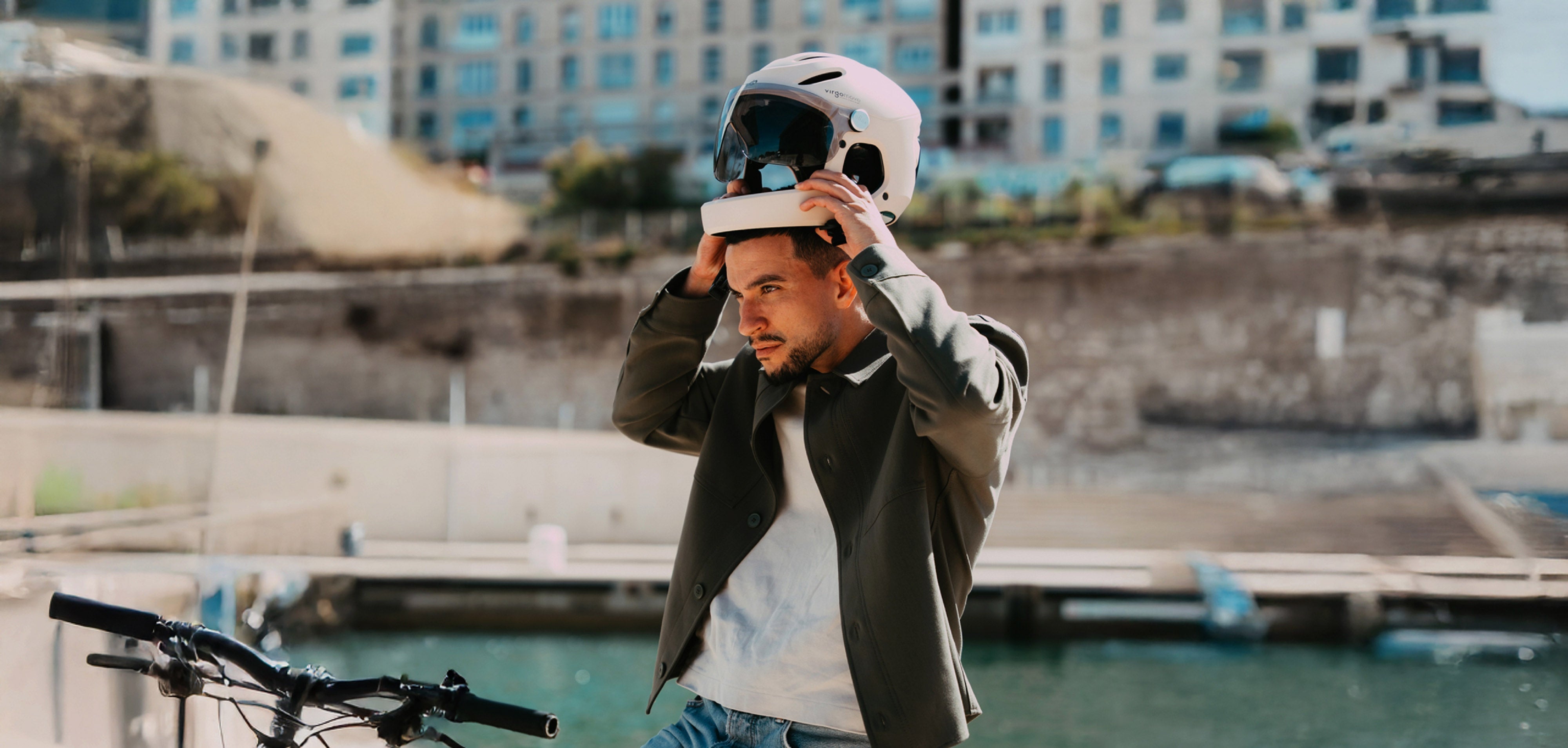
With the rapid growth of electric mobility (e-bikes, speed pedelecs, electric scooters), safety has become a central concern. Average speeds are increasing, uses are evolving, and accident scenarios are closer to those of motorized traffic than traditional cycling.
We have made a clear choice: to design Virgo Move full-face helmets around the strictest and most recognized safety standards in the world, while going beyond minimum requirements through complementary testing and a continuous improvement approach.
Our goal is not simply to "be certified," but to offer protection genuinely adapted to the new speeds of electric mobility, anywhere in the world.
Why standards and independent testing are essential
Safety standards form an indispensable foundation: they ensure that a helmet meets precise criteria for design, shock absorption, and retention. But not all standards are equal, and above all, a certification alone doesn't tell the whole story.
That's why more and more industry players are complementing regulatory certifications with comparative real-world tests, including rotational impacts, now recognized as one of the main factors in head trauma.
Standards chosen by Virgo Move: a high level of demanding requirements
We have deliberately developed our helmets around three major certifications: EN 1078, NTA 8776, and ASTM F1447-18 & F1446-20.
[Image of helmet safety standards comparison EN 1078 vs NTA 8776 coverage areas]EN 1078: the essential European base
The EN 1078 standard governs helmets for cyclists, roller skaters, and skateboarders. It defines requirements for construction, shock absorption, and the effectiveness of the retention system.
NTA-8776: the reference for fast e-bikes
Specifically developed for speed pedelecs (45 km/h), it goes far beyond EN 1078:
- Impact tests at higher speeds.
- Protection area extended to the temples and back of the head.
- Reinforced energy absorption.
ASTM F1447-18: the North American reference standard
Mandatory in the United States and Canada, it guarantees a consistent level of safety internationally.
A design conceived for real impacts, not just tests
Regulatory standards primarily evaluate linear impacts. However, in the majority of accidents, impacts are oblique and rotational.
[Image of MIPS technology rotational force protection mechanism]That's why our helmets integrate the Mips system, designed to reduce rotational forces transmitted to the brain. For us, safety is based on a global approach: monocoque structure, high-performance materials, and dynamic stability.
Virgo Move helmet crash tests: strict specifications
To meet these certifications, our helmets undergo a battery of rigorous tests in specialized laboratories:
- Vertical and oblique impacts.
- Penetration resistance.
- Strength of the retention system.
- Stability in dynamic conditions.
Virgo Move full-face helmet chin bar: an evolving regulatory framework
Currently, there is no specific European standard to certify a bicycle helmet chin bar. The only reference is the American standard ASTM F1952-22 (downhill mountain biking). The design of the Virgo chin bar is inspired by these facial protection principles to offer maximum safety where frontal impacts are frequent.
Bicycle helmets and motorcycle helmets: different worlds
It is crucial to understand that each standard corresponds to a specific use. An electric bike helmet is not a "small" motorcycle helmet; it is a precision tool for active mobility.
[Image of impact test speed comparison chart for EN 1078 vs NTA 8776 vs ECE 22.06]In 2026, the impact speed tested for an NTA-8776 helmet (22-23 km/h) is higher than that of a classic bicycle, because kinetic energy increases exponentially with speed.
Materials designed for performance and comfort
ABS outer shell: resistance and durability
Known for its high abrasion resistance, it distributes impact energy.
EPS inner liner: energy absorption
High-density expanded polystyrene (EPS) dissipates forces before they reach the head.
[Image of helmet anatomy ABS shell and EPS liner cross-section]Comfort and ventilation
With 9 vents and modular pads, the helmet remains stable and breathable for intense daily use.
Virgo Move's long-term vision for safety
Once certification is obtained, the work continues. With our design office DMO Brand Solution, we analyze field feedback to anticipate future standards and integrate the best technological advances.